
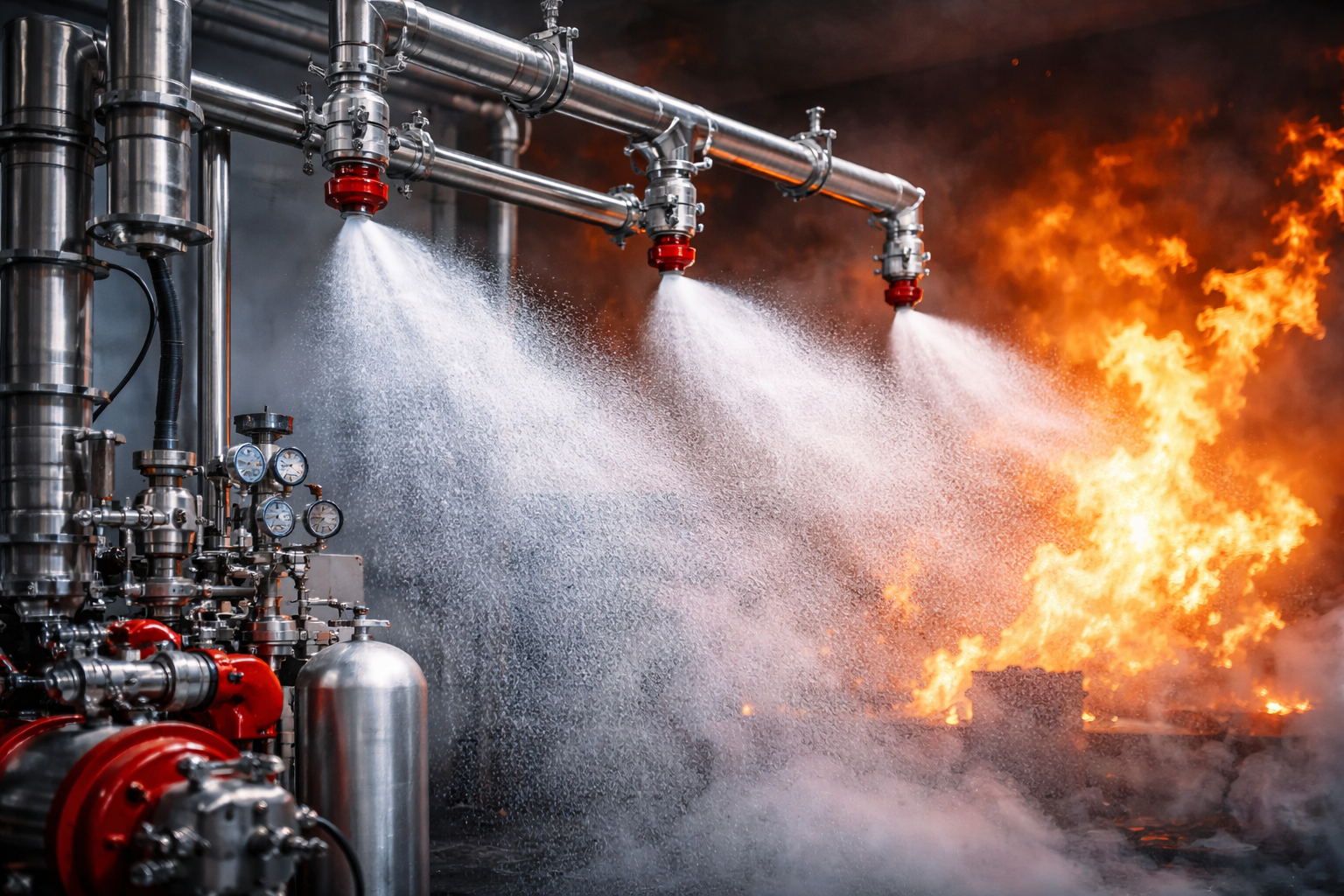
What is a Watermist Fire Suppression System?
A Watermist Fire Suppression System is a specialized fire protection system that uses ultra-fine water droplets (typically less than 1000 microns) to suppress, control, or extinguish fire. Unlike conventional sprinkler systems that release large volumes of water, watermist systems discharge microscopic droplets that absorb heat quickly and displace oxygen at the fire source.
This technology is recognized under global fire safety standards such as NFPA 750 by the National Fire Protection Association and international fire testing protocols supported by the International Organization for Standardization (ISO).
How Does a Watermist Fire Suppression System Work?
The effectiveness of a Watermist Fire Suppression System lies in its three-layer fire suppression mechanism:
1️⃣ Rapid Cooling
The fine mist droplets create a massive surface area that absorbs heat extremely fast. When exposed to flames, the droplets evaporate into steam, cooling the fire rapidly.
2️⃣ Oxygen Reduction
As water converts into steam, it expands up to 1,700 times its volume. This expansion displaces oxygen around the fire, reducing combustion.
3️⃣ Radiant Heat Blocking
Watermist creates a protective barrier that limits radiant heat transfer, preventing the fire from spreading.
This multi-dimensional suppression approach makes Watermist Fire Suppression Systems highly effective for complex fire hazards.
Key Benefits of a Watermist Fire Suppression System
✅ 1. Uses Up to 90% Less Water
Compared to traditional sprinklers, watermist systems dramatically reduce water consumption.
✅ 2. Minimal Property Damage
Less water means reduced damage to interiors, equipment, and infrastructure.
✅ 3. Environmentally Friendly Fire Protection
No toxic chemicals. No harmful gas discharge. Safe for occupants and environmentally sustainable.
✅ 4. Safe for Occupied Spaces
Unlike gas suppression systems, watermist can be used in areas where people are present.
✅ 5. Lower Infrastructure Requirements
Smaller pipe sizes, reduced water storage, and flexible installation options.
✅ 6. Effective for Multiple Fire Classes
Suitable for:
Electrical equipment (when properly designed)
Class A (solid materials)
Class B (flammable liquids)
Applications of Watermist Fire Suppression Systems
Watermist technology is widely used in:
🔹 Data Centers & Server Rooms
Protects critical IT infrastructure with minimal water damage.
🔹 Hospitals & Healthcare Facilities
Safe for occupied and sensitive medical environments.
🔹 Hotels & High-Rise Buildings
Efficient vertical fire protection with reduced pipe sizes.
🔹 Industrial Plants & Machinery Spaces
Effective for turbines, engines, and high-risk equipment.
🔹 Marine & Offshore Platforms
Approved for shipboard fire protection under IMO standards.
🔹 Museums & Heritage Buildings
Protects valuable artifacts without soaking them in water.
Compliance and Standards
Watermist Fire Suppression Systems are regulated under international guidelines such as:
- National Fire Protection Association (NFPA 750 Standard for Water Mist Fire Protection Systems)
- International Organization for Standardization (ISO standards for fire safety systems)
Compliance ensures system reliability, safety, and performance.
Is a Watermist Fire Suppression System Right for You?
If your facility requires:
- Protection of high-value assets
- Reduced risk of water damage
- Eco-friendly fire protection
- Efficient performance in confined spaces
Then installing a Watermist Fire Suppression System could be the ideal solution. Consulting with certified fire protection engineers ensures proper system design tailored to your building requirements.
Watermist Fire Suppression System vs Traditional Sprinklers
| Feature | Watermist Fire Suppression System | Traditional Sprinkler |
|---|---|---|
| Water Usage | Very Low | High |
| Water Damage | Minimal | Significant |
| Pipe Size | Smaller | Larger |
| Environmental Impact | Eco-Friendly | Moderate |
| Installation Flexibility | High | Standard |
| Protection of Electronics | Excellent | Limited |
Cost of a Watermist Fire Suppression System
The cost of a Watermist Fire Suppression System depends on:
- Building size
- Hazard classification
- Pump type (high-pressure or low-pressure system)
- Water source availability
- Regulatory requirements
Although initial installation may be slightly higher than traditional sprinklers, long-term savings in water damage, maintenance, and infrastructure make it cost-effective.
Future of Watermist Fire Suppression Systems
The future of fire safety is shifting toward:
- Smart fire suppression integration
- IoT-enabled detection systems
- Sustainable building compliance
- Compact, modular watermist units
As climate regulations tighten and property values rise globally, Watermist Fire Suppression Systems will become a standard requirement in modern construction.
With growing emphasis on sustainability, asset protection, and regulatory compliance, Watermist Fire Suppression Systems are rapidly gaining popularity worldwide. Their advanced technology, efficiency, and minimal environmental impact make them a future-ready fire protection solution.
As industries continue upgrading their fire safety infrastructure, adopting a Watermist Fire Suppression System is not just an option — it’s a smart investment in safety and sustainability.
Conclusion
A Watermist Fire Suppression System offers superior fire control, minimal damage, and environmentally responsible protection. Whether you manage a commercial building, industrial facility, or specialized environment, investing in this innovative system ensures enhanced safety and long-term cost savings.
If you’re considering upgrading your fire safety system, now is the time to explore the benefits of a Watermist Fire Suppression System and stay ahead in fire protection technology.
Frequently Asked Questions (FAQ)
- What is water mist fire suppression?
A water mist system disperses a fine mist or fine water spray of small water droplets to extinguish fire using a number of different mechanisms: cooling or heat absorption from a flame; oxygen dilution by displacing oxygen; absorption of radiated heat; and chemical inhibition of the flame radicals. - How to operate a water mist system?
The system directly detects the fire at the heart of the engine and quickly suppresses it at its source. No human intervention is required, the water mist system is automatic and can operate 24/7. - When to use water mist?
Water mist systems are commonly used in areas where traditional fire suppression methods, such as sprinklers, may not be effective or may cause excessive water damage, such as in data centers, museums, and historic buildings. - What are the Top 5 Benefits of Water Mist Fire Suppression Systems?
Top 5 Benefits of Water Mist Fire Suppression Systems:
Rapid Fire Suppression with Minimal Water Usage.
Safe for Sensitive Equipment and Environments.
Environmentally Friendly and Non-Toxic.
Flexible for Various Applications.
Compliance with Global Fire Safety Standards. - What type of extinguisher is a water mist?
WATER MIST is the ultimate extinguisher for Class A fires and where a potential Class C (electrical) hazard exists. The fine spray from the unique misting nozzle provides safety from electrical shock, greatly enhances the cooling and soaking characteristics of the agent and reduces scattering of burning materials. - What are the 4 types of water fire extinguishers?
There are four different types of water fire extinguisher: water jet, water spray, water with additives and water mist or fog. - Can a water mist system replace a sprinkler?
A water mist system is a fire protection system that produces a fine spray to suppress fires – a common alternative to traditional large droplet, fire sprinklers. Water is the oldest, most widely used, and universally available firefighting agent known to man. - What are the four types of fire suppression systems?
Water-Based Fire Suppression Systems
Chemical-Based Fire Suppression Systems
Inert Gas Fire Suppression Systems
Foam-Based Fire Suppression Systems - How many volts is a water mist fire extinguisher?
Water mist fire extinguisher is tested for use on electrical equipment up to 35000 Volts and leaves no residue. - What are the different types of watermist system operation?
Wet pipe system (automatic nozzles)
Dry pipe system (automatic nozzles)
Deluge system (open nozzle)
Pre-action system
Electronically Controlled - Which chemical is used in a water fire extinguisher?
Powder fire extinguishers used to use sodium bicarbonate or potassium bicarbonate, which made them suitable for Class B and Class C fires, but not Class A. Modern versions contain mono-ammonium phosphate powder and can be used on Class A fires as well. - What is the NFPA code for water mist system?
Water mist fire protection systems extinguish fires by displacing oxygen through water vapor, cooling the flames and reducing radiant heat. NFPA 750 details general requirements, along with provisions for all types of water mist systems, components, and hardware. - Is a Watermist Fire Suppression System better than sprinklers?
Yes, especially for sensitive environments where water damage must be minimized. - Is watermist safe for electrical fires?
Yes, when designed correctly with proper droplet size and system pressure. - Is watermist environmentally friendly?
Absolutely. It uses only water and no harmful chemicals. - Does watermist meet international standards?
Yes, systems are designed according to NFPA 750, ISO, and IMO guidelines.

