
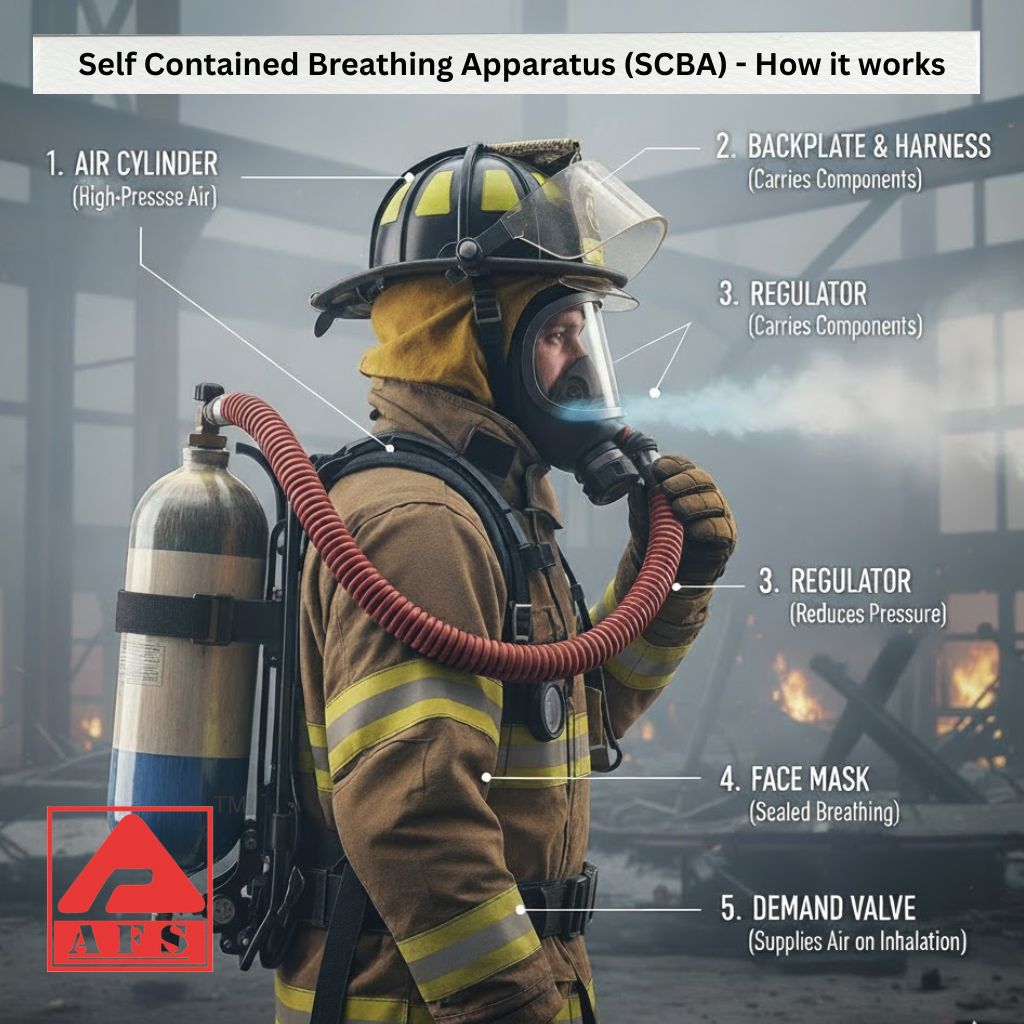
In a dangerous place where smoke, harmful gases or lack of oxygen can be a big risk, a Self-Contained Breathing Apparatus has become crucial lifesaver tool. It mainly used by firefighters, rescue squad and workers in various industries, AFS fire safety enables them to breathe safely and perform their task effectively in hazardous condition. Understanding how SCBA works its components and operations is essential for ensuring safety, reliability and proper use in emergency or in tight spaces.
What is a Self-Contained Breathing Apparatus?
A Self Contained Breathing Apparatus is a piece of equipment that provides breathable air from its own source, allowing the user to work in environment with poor air quality. Unlike air purifying respirators, SCBA don’t depends on an outside air, they come with their own air supply and ensuring full respiratory protection.
Components of Self-Contained Breathing Apparatus
- Air Cylinder: It serves as the main source of air, constructed from high strength steel, aluminum or carbon fiber composite. It holds a breathable air usually at the pressure between 200 – 300 bar, to keep the use going, depending on the usage and capacity.
- Pressure Regulator: This part lowers the high pressure air from the cylinder to a level that can be breathed. The regulator guarantee a consistent airflow and avoiding sudden bust.
- Face Cover: The facemask makes an airtight seal, safeguarding the eyes and respiratory system from harmful pollutants and dust. It comes with a voice diaphragm and an anti-fog visor which allows us for clear communication and visibility in smoky conditions.
- Second Stage Valve: This is also known as demand valve supplier – air to the user as they breathe in optimized air usage and extending the operational duration of Self Contained Breathing Apparatus.
- Pressure Gauge or Warning Whistle: The pressure gauge displays the remaining air supply while the warning whistle signals when the air level drops sown to the certain point.
How to Operate Self Contained Breathing Apparatus?
- Compressed air passes through the system and then to the regulator when the user opens the cylinder valve.
- The demand valve receives the high pressure air when the regulator lowers it to a safe level.
- As the demand valve opens and air is delivered into the mask by the regulator when the user inhales.
- The air is send into the atmosphere through the exhalation valve when the user exhales.
- Pressure gauges indicate how much air is left in the supply as it is consumed, and an alert sounds when the air level falls to a preset level.
Why Choose AFS Fire & Safety
AFS Fire Safety is a reputable brand known for providing reliable and high quality safety services, such as modern edge Self Contained Breathing Apparatus system. We prioritize innovation, certified products and keeping customer happy, ensuring total protection and effectiveness in crucial moments. Our expert support and dedication to safety make them a go – to option in various industries.
Conclusion
Self-Contained Breathing Apparatus is more than just protective gear, it is a lifeline in hazardous situations. We want to optimize user safety, maintain equipment correctly and can react to emergencies more skillfully if the users are aware of its parts and how it works. Every SCBA by AFS Fire & Safety is guaranteed to operate flawlessly when it counts to routine training and inspection.
Frequently Asked Questions (FAQs)
- What is the use of self-contained breathing apparatus?
The SCBA supplies the compressed air from the air cylinder to the wearer through cylinder valve, pressure reducer, pressure demand valve or demand valve. Exhaled air goes to the atmosphere through exhalation valve. Please use in combination with a high-pressure air cylinder. - Is SCBA 100% oxygen?
No, Self-Contained Breathing Apparatus (SCBA) tanks used by firefighters and industrial workers are not 100% oxygen; they are filled with normal, ambient air (about 21% oxygen and 79% nitrogen) that’s filtered and compressed, as pure oxygen creates a severe explosion risk in fire conditions. Using pure oxygen in a fire environment is extremely dangerous and would cause materials to ignite violently, whereas compressed air is safe and standard for breathing. - What are the two types of SCBA?
There are two primary types of SCBA, open circuit and closed circuit. Open circuit SCBA are useful for longer rescue operations or shifts on an oil rig. This type of SCBA continuously recycles the air, creating an endless open circuit of air for the wearer to breathe. - What are the 4 components of SCBA?
The SCBA is comprised of four parts: regulator, cylinder, back plate and harness, and face piece. No matter what brand of SCBA you are using, they all have these four basic components. - What are the 5 checks of SCBA?
Key elements of the daily and general SCBA check:
Visual inspection of backplate, harness, fabric, straps, and fixtures.
Cylinder-to-set connection and O-ring integrity.
Pressure reducing valve and high-pressure line condition.
Gauge check glass, whistle port, zero position.
Medium pressure line and demand valve checks. - What are the benefits of SCBA?
The self-contained breathing apparatus, or SCBA, is the foundational tool that provides the greatest amount of airway protection from toxic gas and harmful particulates resulting from the fire. It’s essential for modern firefighting and today’s complex fire grounds. - Which gas is used in SCBA?
The air source can be a tank of compressed air, compressed oxygen, or an oxygen-generating chemical. - How many minutes to wear SCBA?
The duration of usage for breathing apparatus is between 10 minutes (short-term SCBA) up to about 45 minutes (long-term SCBA). Depending on requirements, you can use cylinder volume, pressure and thus the amount of compressed air specific to your application. - How much oxygen is 4 litres?
At 4 LPM, the approximate FiO2 is 36%. - What is the minimum pressure for SCBA?
SCBA air cylinders shall be pressurized between 4000 and 4500 psi. The minimum acceptable air pressure for a stored SCBA air cylinder is 4000 psi. - What are two primary types of SCBA?
SCBA systems fall into two general categories: open- circuit (OC) and closed-circuit. - What is the oxygen level for SCBA?
To ensure that employees have a reliable source of air with an oxygen content of at least 19.5 percent.

